The Case for Automating Due Diligence Across the Enterprise
Mar 20, 2026
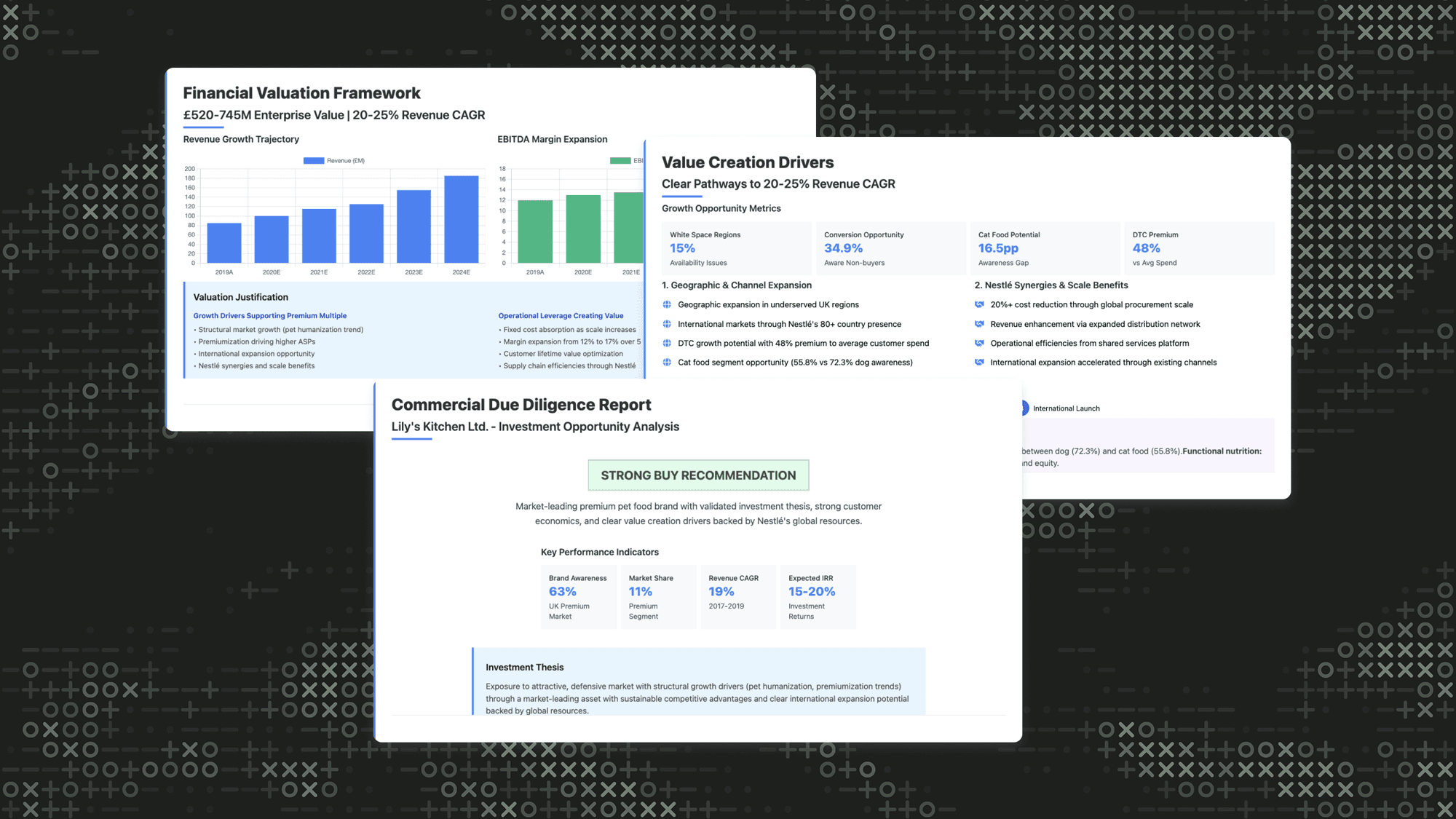
Commercial due diligence is often framed as a deal-specific exercise. In practice, it is a recurring pattern of work across the enterprise. Any diligence process is meant to answer a small number of high-stakes questions under intense time pressure:
Is the market real and durable?
Where does growth actually come from?
What fails under stress: pricing, churn, competition, regulation?
Which risks are understood, and which are quietly glossed over?
Diligence shows up in procurement cycles, vendor risk assessments, M&A transactions, IPO preparation, strategic partnerships, and internal investment decisions. Each case demands the same outcome: making a defensible decision under time pressure using large volumes of sensitive information.
The questions vary, but the constraints do not. Data lives in secure systems. Timelines are compressed. Errors carry real financial and reputational cost.
Where Diligence Work Breaks Down
Enterprises are not short on data. They are short on time and structure. Teams spend weeks reconciling duplicated materials across spreadsheets, PDFs, slide decks, and exports. Definitions for core metrics differ by department. The same analyses are rebuilt repeatedly for different decisions. As deadlines approach, conclusions become harder to trace back to original sources with confidence.
This friction compounds. Procurement teams redo vendor diligence at every renewal. Finance teams repeat revenue and market analysis ahead of an IPO. Corporate development teams rebuild diligence frameworks deal after deal. The work is familiar, but rarely reusable.
Automation Changes the Equation
Automating diligence, when done correctly, is not about replacing judgment. It is about removing the manual, error-prone work that consumes expert time.
Structured automation allows enterprises to standardize how diligence questions are framed, which data sources are approved, and what constitutes a defensible output. Instead of starting from scratch, teams reuse governed workflows that reflect institutional knowledge.
That matters across functions:
Procurement: automation supports consistent vendor evaluation and earlier risk identification.
M&A: it accelerates analysis of market size, growth drivers, revenue quality, and customer concentration under deal pressure.
IPO preparation: it enables repeatable analysis across disclosures, forecasts, and historical performance.
Internal strategy and capital allocation: it ensures leadership works from aligned assumptions and traceable evidence.
Why Generic AI Falls Short
Many teams attempt to automate diligence with general-purpose AI tools but that approach introduces risk.
Diligence data is highly sensitive, and industry reporting shows a sharp rise in AI-related data policy violations tied to unmanaged tool usage. EY research indicates that nearly all companies deploying AI have experienced some form of risk-related financial loss, often linked to weak governance and controls (Reuters; EY; TechRadar; ITPro; Cybersecurity Dive).
Accuracy is another issue. General-purpose models still produce confident errors and unsupported claims, which can undermine diligence outputs at the worst possible moment.
Most importantly, these tools are not designed for repeatable, auditable production use. Automation without structure simply accelerates inconsistency.
What Diligence-Grade Automation Requires
Effective automation starts with constraints and depends on structure more than speed.
Diligence-ready systems define scope before execution, enforce approved data sources, preserve evidence, and produce outputs that can be inspected and reused. The goal is not speed alone, but reliability at scale.
Capitol is built for this reality. It enables enterprises to automate diligence workflows across procurement, transactions, and strategic decisions. Rather than helping teams generate drafts or fragments, Capitol produces finished, decision-grade artifacts from proprietary data without moving that data outside enterprise boundaries. For diligence teams, this supports work such as market and growth analysis grounded in explicit assumptions, revenue quality assessments that reconcile multiple systems, competitive landscapes built from observable customer evidence, and customer voice synthesis that maintains context as pressure increases.
The Payoff
Commercial due diligence doesn’t fail because teams lack intelligence. It fails when conclusions can’t be defended with confidence. When automation is applied thoughtfully, enterprises reduce cycle time, improve consistency, and free expert teams to focus on judgment rather than information management.
Capitol exists to close that gap by turning complexity into clarity that holds up when the stakes are highest.